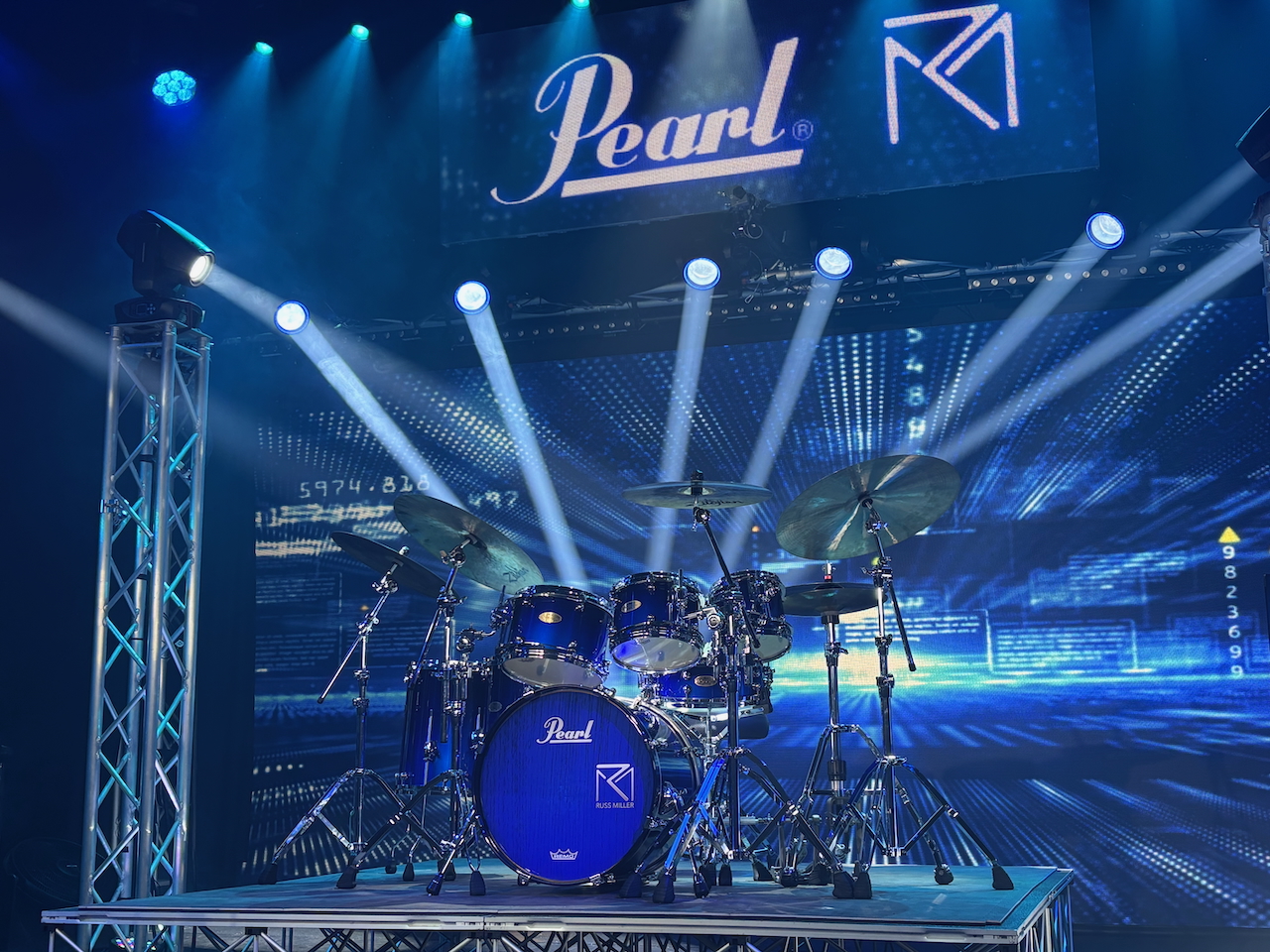
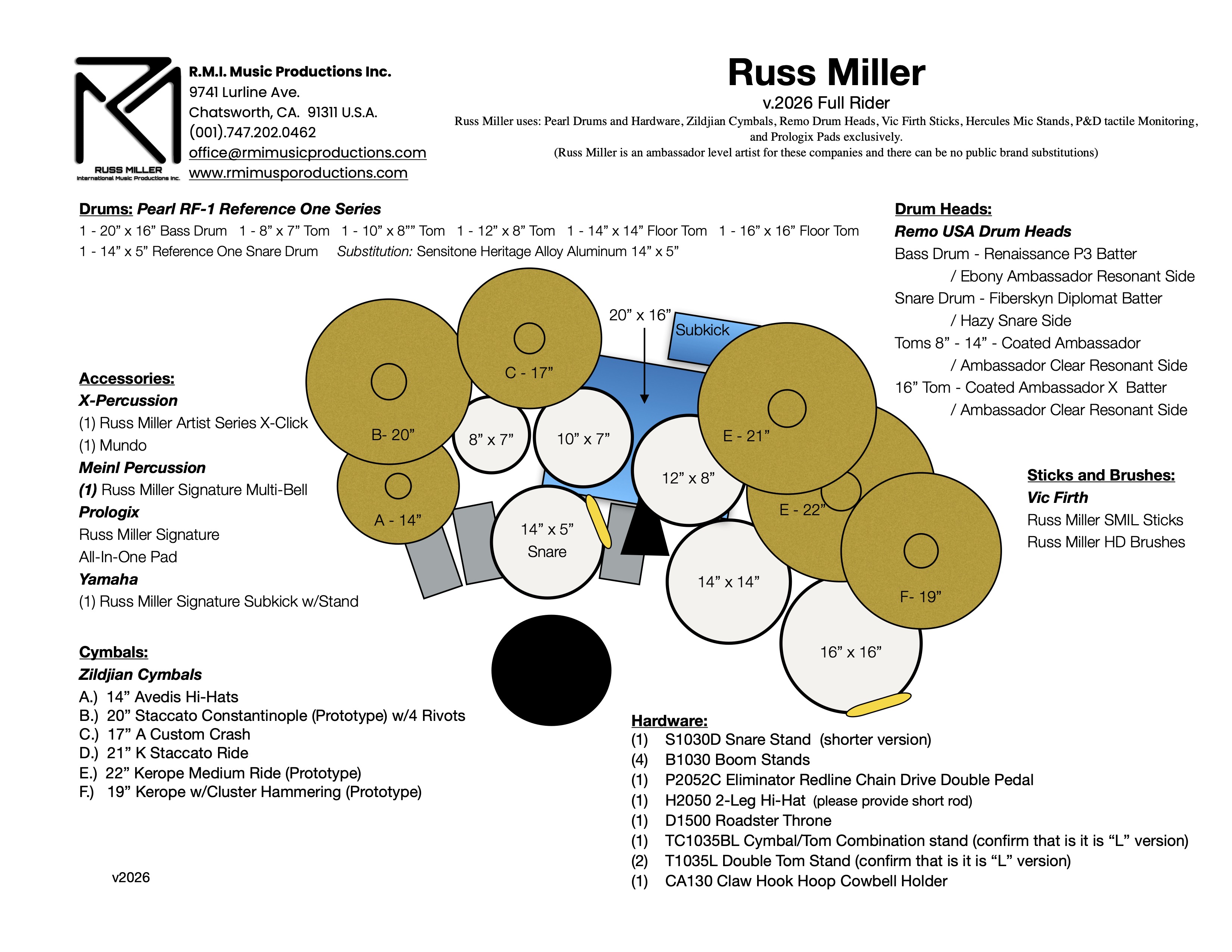
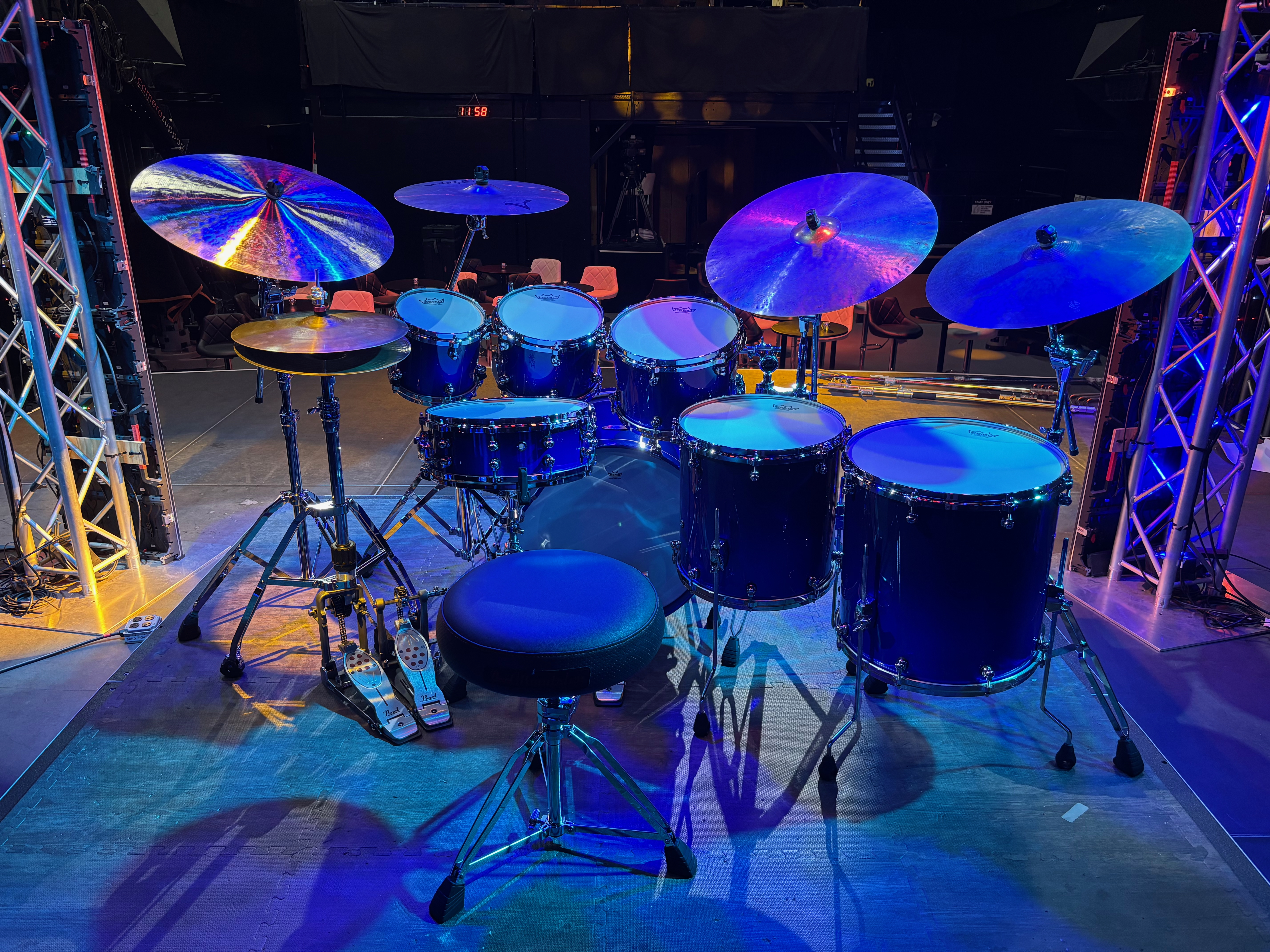
Full Set-up (Details)
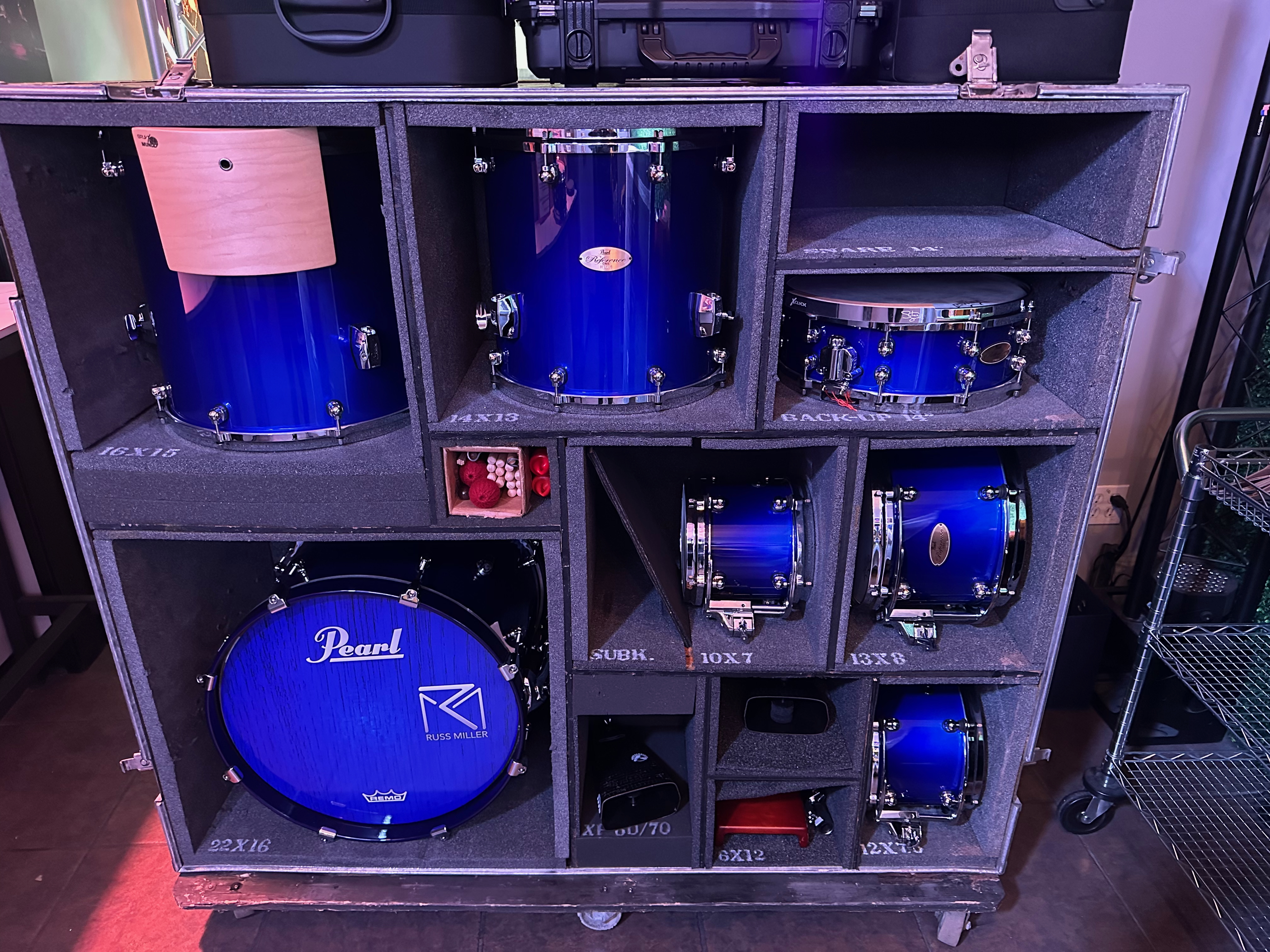
Russ' Electronics “Road Rack”
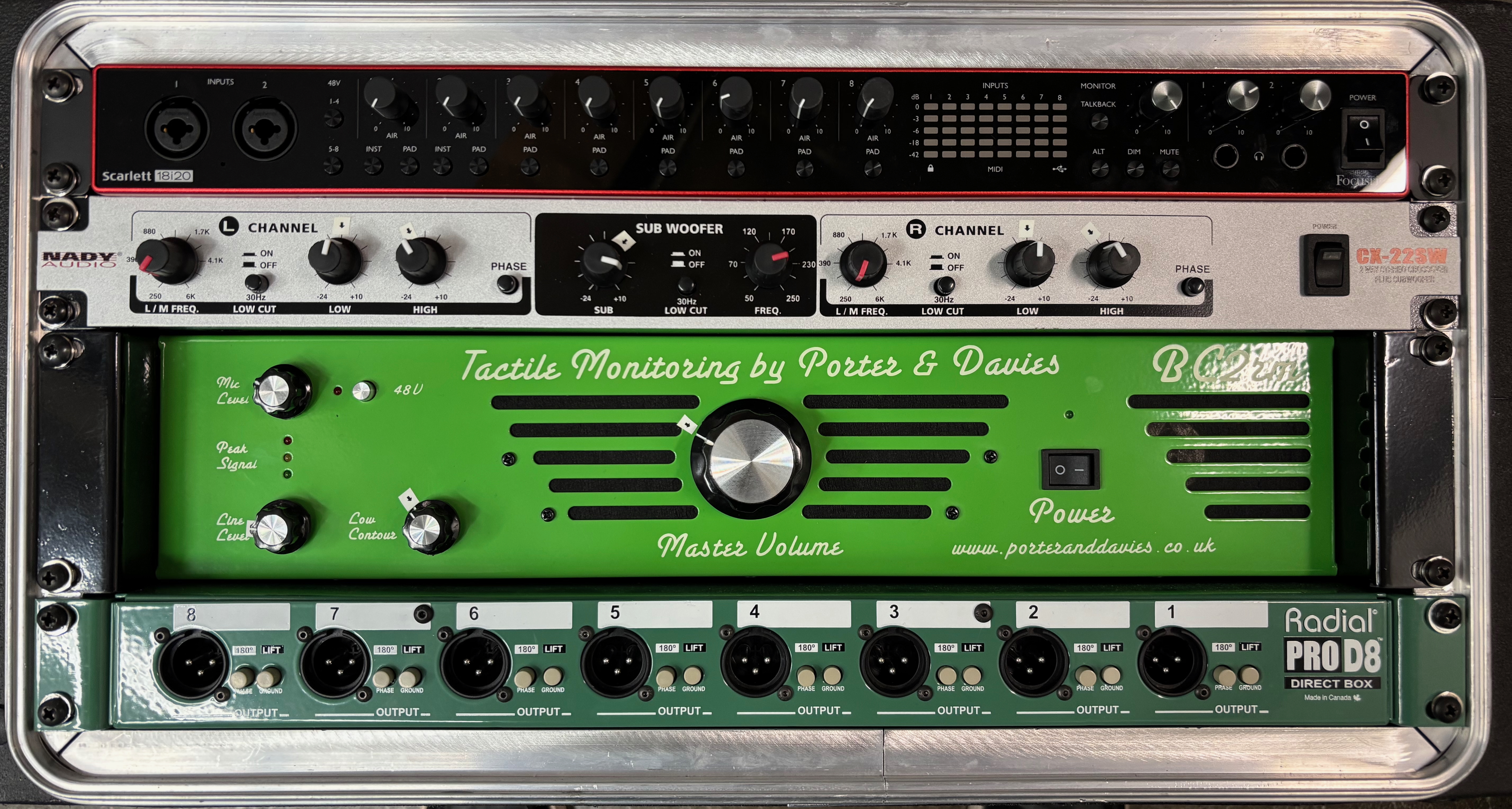
Russ comments regarding his live performance rack, “I've gotten tons of requests to show and detail my electronics road rack. I designed this to be able to use live and in the studio. It basically consists of my electronic percussion sources, audio outputs and my personal IEM (in-ear monitoring) with the ”Porter and Davies Tactile Monitor in the throne". Russ uses Apple "Mainstage" on an Apple Laptop. This runs Logic with an EX24 sampler. It also contains Toontrack, Spectrasonics RMX and BFD as sound sources for drums and percussion sounds. The audio interface for this, is a Focusrite Scarlett 18i20. “When we are doing live shows with “Arrival”, “Livetracker” is used to playback the fly-in files, sync'd with video. This is a software used for playback with sync'd video combinations. Livetracker outputs through the same Focusrite interface and has 6-channels of fly-in outputs (background vocals or synths, horns and strings, Percussion and Loops (as mono) and a click track. The outputs are running directly out of the Radial DI's in the rack". He uses the Alternate Mode “DITI” for the trigger to MIDI interface for the sampled sounds with the X-Percussion “Arc” or Pearl “E-Merge” pads. Russ Explains, “Most of the sounds are pulled directly from the original session's pro-tools files. Although, I do have a pretty extensive sample library I've built up, from doing all of the Yamaha samples back in the day, the Nfuzed system samples and many of my own, that I've created as a general sound palette when I was on American Idol”.
The rack is set-up as follows:
The Focusrite interface outputs are sent directly to the Radial DI outputs and onto the Splitter for FOH and monitors. There is 6-out for Arrival's show and usually just 4-outs for my drum and percussion sounds. A stereo pair left ove for each set-up, to output a Multi-pad, or other external sound source. The IEM mix is sent into the Nady CX-223W cross-over. Everything above 150hz gets sent to Russ' in-ear pack (Shure 900 wired series that outputs from of the Nady) and everything below 150hz, gets sent to the Porter and Davies BC2RM throne tactile monitor (thumper throne) amp. Russ explains, "Sometimes I run the click into a separate small mixer (Behringer 4-channel) and then I send it to FOH, as an AUX send from the mixer. By doing this, I get the click before FOH, so I never have to worry about not having a solid monitoring of the click for the performance". They send me the band monitor mix and it feels and sounds great to have the P&D system in the throne… for everything in the band! The entire system only takes up a 5-Space SKB rack."
Russ' Pearl “Eliminator Redline” pedal set-up
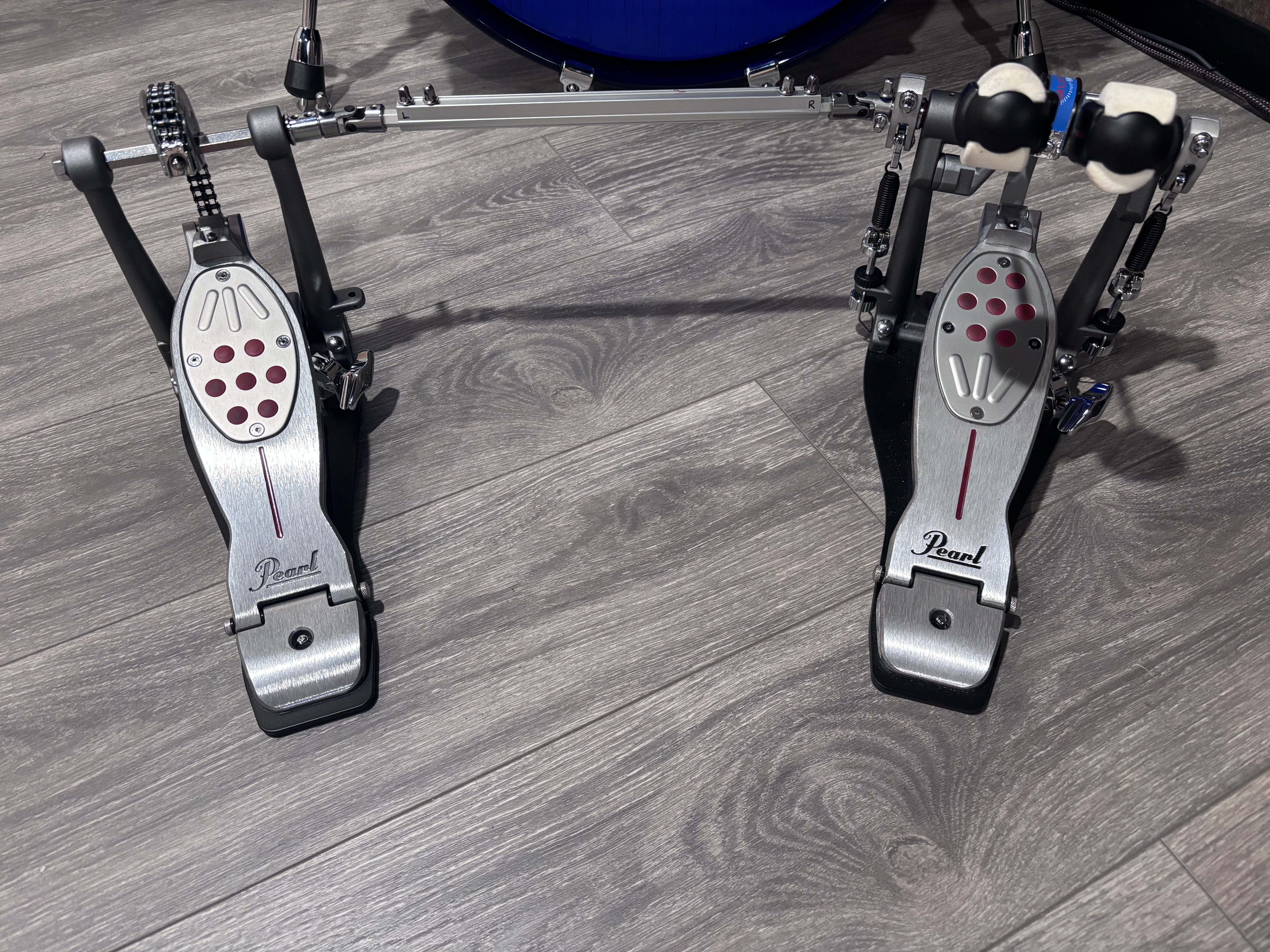
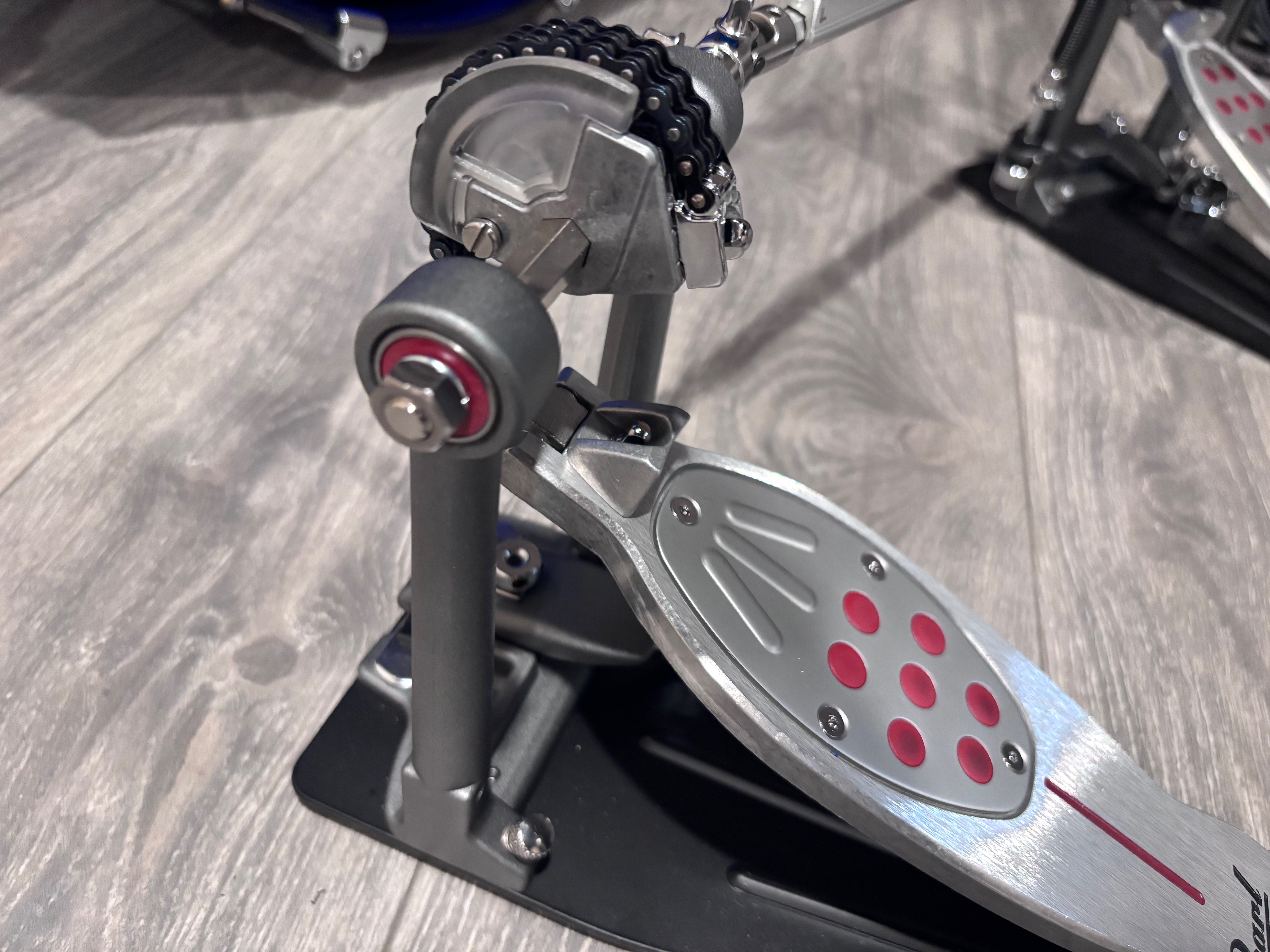
“Since i've been using Pearl drums, I've been asked about my (Eliminator Redline) pedal set-up. These are the best pedal systems I've ever seen, totally customizable to your playing. A huge part of my sound and feel is using dynamics in the bass drum parts. I think it is so important to have a great dynamic range with the bass drums. The pedals are a huge part of that. Many of the manufacturers make these ”styled" pedals with a lot of throw to them and an artificial power cam/beater set-up. They are very had to play light with them. Playing hard is great and with speed but playing light with a short beater height control, is next to impossible with some of the pedals out there! The Eliminators end the suffering with this. They come with optional cams and you can get the different drive options as well. The beaters even have 4 different sounds! So to detail what I use:
The Primary pedal has the “black-linear” cam on it, which is the smooth, even throw across the entire dynamic range. I also use the belt drive on the primary pedal, this is a lighter feel and it really helps with the subtlety of “feathering” the bass drum at a very small beater height. Of course, lifting the leg higher will make it louder, thats no problem! I use the flat-felt side of the beater on the primary for the same reasons, getting a nice, fat tone out of the bass drum at all dynamics. The pedal grips are shifted to the top of the footboard on the primary because I play a bit higher in the footboard position on this pedal.
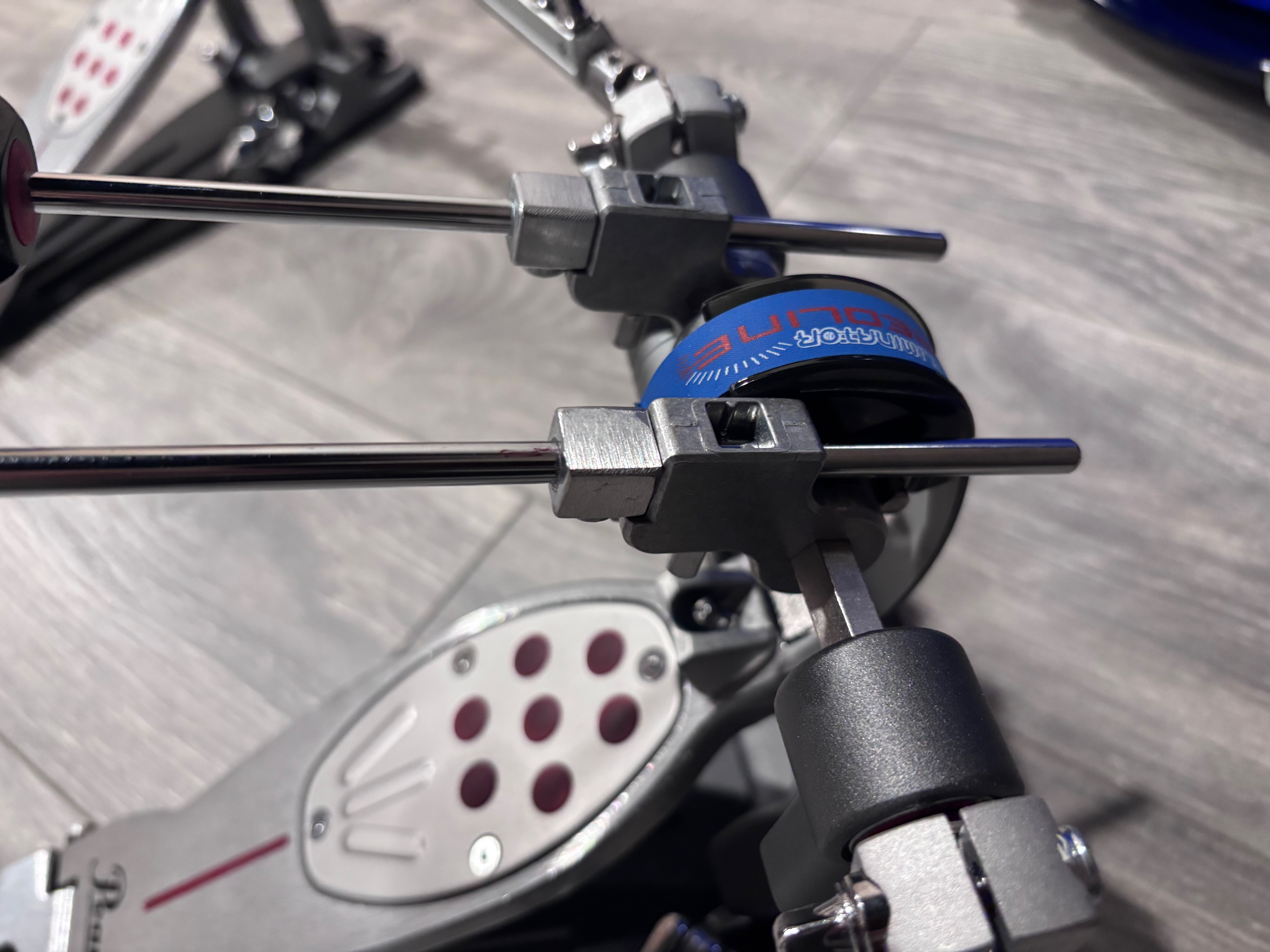
The slave pedal has the “white-oversized linear” cam on it, which has the smooth dynamic range but just a bit more “throw” to it. This helps with an even sound between the primary and slave tones. My left foot is not as strong or developed as the right, so the pedal gives it a bit of help! I also use the chain drive on the slave pedal. 90% of the time, when using the slave pedal for double-bass sounding patterns, the volume is greater. I want the left to have the presence and power of the primary right foot. Using this white cam and chain drive, makes a huge difference in the pedal response. I also use the rounded-felt side of the beater on the slave pedal. The pedal grips are in the lower position on the slave pedal, as I usually play down the footboard a bit on the slave pedal.